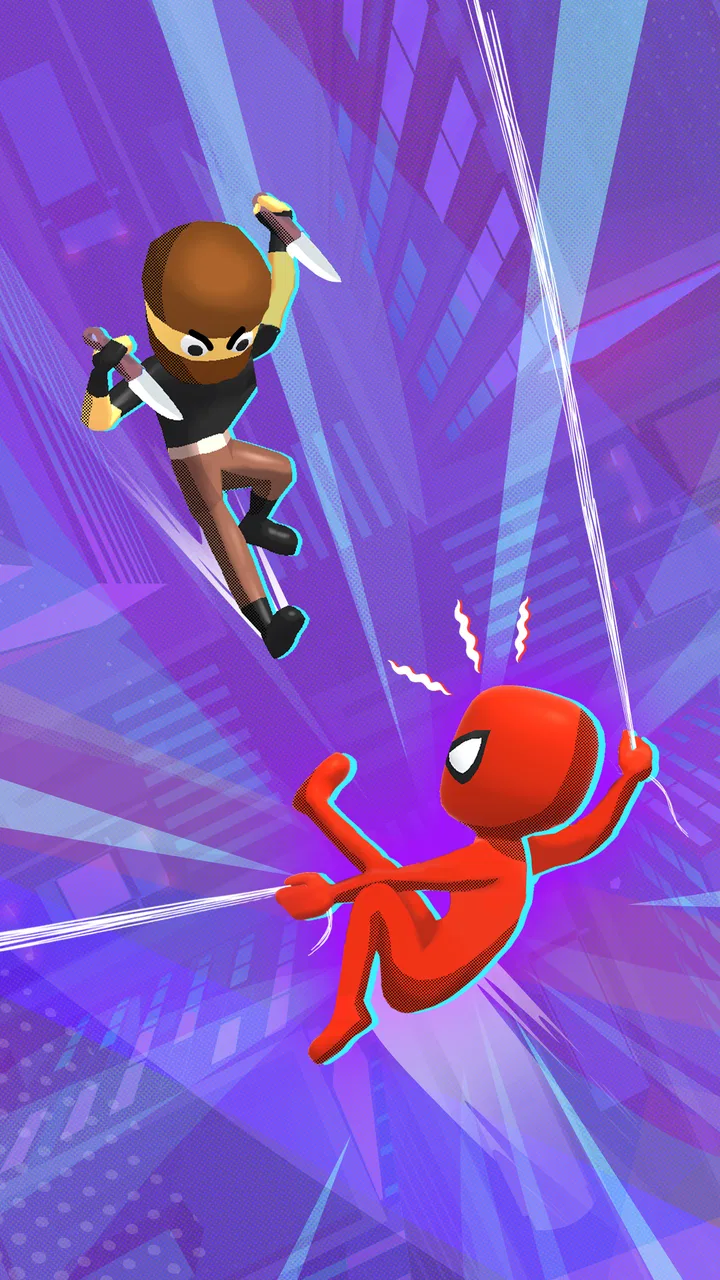
Web Master: Stickman Superhero
- 4.5
- Rating
- 50.00M
- Installs
- Free
- Price

 Analysis by App-foxy
I spent time with Web Master: Stickman Superhero as a quick-play arcade game, and its appeal is easy to understand: it turns a stickman into a nimble hero who uses a web to move, escape danger, and attack enemies. The basic idea is immediately readable, but the game becomes more interesting when I stop treating every screen as a simple shooting challenge and start thinking about movement, timing, and the safest route through each encounter.
That makes it a good fit for short sessions rather than a game I would choose for a long, story-heavy evening. It is free to download, supported by optional in-app purchases ranging from $1.99 to $9.99 per item, and it carries an Everyone 10+ content rating. CASUAL AZUR GAMES is the developer, and the game belongs firmly in the casual arcade space: fast to understand, easy to pick up, and built around repeated attempts rather than a complicated tutorial or a large amount of reading.
How the game communicates action and movement
I found that the game’s clearest design choice is how it uses web movement to make position part of every action, not just a way to cross the screen. That shifts my attention from tapping at the nearest enemy to planning where the stickman will land and what that move leaves open. In the next section, I’ll look at how that idea changes the rhythm of a typical encounter.
You May Also Like

 Blood Strike: 2.5 Anniversary
Blood Strike’s Loadouts Turn Every Drop Into a Tactical Gamble
A close look at Blood Strike’s custom loadouts: how fast access to signature weapons reshapes its battle royale rhythm, rewards preparation, and narrows the gap between fights.

 Pandora - Music & Podcasts
Pandora’s Music Is Easy to Start, but Harder to Recover
Pandora’s strength is its low-effort path from a seed to a station. Its weak spot is how much confidence it asks you to place in connection, setup, and quiet recovery.

 8 Ball Pool
 Is Built on Rivalries, Rematches, and Routine
A close look at the rivalries, rematches, shared routines, and unanswered safety questions that turn a quick pool match into a persistent mobile community.

 Samsung Music
’s Quiet Strength Is Playing What You Already Own
Its reach comes less from spectacle than from dependable access to a personal library. That simplicity is both the app’s strongest retention engine and its ceiling.

 AccuWeather: Weather Radar
AccuWeather Review: A Quick, Clear Forecast for Everyday Decisions
For everyday plans, the best forecast is the one you can understand quickly. AccuWeather makes rain timing, radar, and local conditions easy to act on, with a few trade-offs.

 Hill Climb Racing
Why Hill Climb Racing Still Turns Crashes Into One More Run
A tiny car, a bumpy hill and one more upgrade: Hill Climb Racing keeps resurfacing because its simple chaos makes every near-miss feel personal.
More From Our News Desk



Readability and navigation
The strongest part of the presentation is its visual simplicity. A stickman character, enemies, platforms, and web-based movement form a much cleaner picture than a crowded action game with several meters, menus, and layers of interface. I could usually tell what the immediate problem was without stopping to study a long explanation. That matters when the game expects a quick reaction, because extra visual noise would make the central movement feel less fair.
The web mechanic also gives the game a clear visual identity. Rather than relying only on ordinary running and jumping, the character can use the web to change position and reach a better angle. In practice, I found that the most useful question was not simply “Which enemy should I shoot?” but “Where will I be after this move?” That small change in thinking makes the levels feel more like compact spatial puzzles inside an arcade framework.
Navigation is approachable for someone who does not normally play action games. The premise is explained through play instead of demanding that I remember a long list of controls. That is helpful for younger players within the age rating, for people returning to games after a break, and for anyone who wants something that can be understood while waiting for a bus or taking a short break.
Still, simple presentation does not mean every moment is equally easy to read. When movement, enemies, and attacks happen close together, the screen can become harder to parse, especially if I am reacting late. The game rewards looking one step ahead, so a player who focuses only on the nearest target may miss a safer route or move into a poor position. I consider that a fair arcade challenge, but it is also the point where the experience becomes less relaxed.
The game’s broad popularity gives some useful context. It has passed 50 million installs and holds a 4.3 average from around 20 thousand ratings, which suggests that its quick, accessible premise has reached a large audience. I would not treat popularity as proof that every player will enjoy it, but it does fit what I experienced: the design aims to make the first few minutes understandable without removing the need to improve.
Learning the controls without a long tutorial
For me, the controls worked best when I treated them as a rhythm. I would identify a target, choose a direction, use the web to create space or gain access, and then reassess the next threat. Trying to perform every action as quickly as possible was less reliable than making each move deliberately. That is a useful tip for new players: speed comes after recognizing the shape of an encounter.
Another practical habit is to avoid committing to a web movement before checking where it will leave the character. A movement that looks helpful because it reaches an enemy can still be a bad choice if it places the hero beside another hazard. This is one of the game’s less obvious strengths. The web is not only an attack tool; it is also a way to manage distance and control the flow of a short scene.
At the same time, players who need very slow pacing may find the action demanding. Arcade games often communicate failure through immediate repetition, and this one is more enjoyable when I accept that a failed attempt is information. If I expect every stage to be calm and predictable, I am likely to find the repeated reactions tiring rather than satisfying.
Motor and sensory considerations
The game’s compact controls are a benefit for players who prefer not to manage many buttons at once. There is no need to memorize a large command set before beginning, and the stickman format keeps the focus on a few important actions. For someone with limited gaming experience, that lower learning burden can make the game less intimidating than a traditional platformer with several movement states and combat combinations.
However, a small control scheme can still require accurate timing. Players with reduced fine-motor control, tremor, slower reactions, or difficulty with repeated taps may find web movement and attacks inconsistent. The challenge is not the number of controls; it is the need to use the right action at the right moment. I would recommend trying a short session before spending money on any optional purchase, because personal comfort with the timing matters more here than the simplicity of the button layout.
One way I made the game more manageable was to separate observation from action. Instead of tapping immediately whenever an enemy appeared, I used the first moment to locate open space and identify the likely direction of movement. That approach reduces frantic input and can help players who become overwhelmed when several visual events happen together. It does not remove the arcade challenge, but it makes the challenge feel more controlled.
Sensory comfort is more difficult to judge universally. The game’s cartoon stickman style is less visually intense than a realistic shooter, and the uncluttered characters are generally easy to distinguish. Even so, quick movement and repeated action can be tiring for players sensitive to motion, flashing effects, or busy transitions. Anyone who is affected by those elements should test the game cautiously and take breaks rather than assuming that a simple art style guarantees a low-stimulation experience.
Sound can also influence how comfortable a session feels, although I would not use audio as the main source of information. I found it better to rely on the visual situation and treat sound as reinforcement. That is useful for players who play with the volume low or muted, but it also means that visual attention remains important. A player who cannot comfortably track rapid movement may not find the game easier simply because the interface itself is minimal.
Situational access in everyday play
This is where the game makes the most sense for me. I could imagine opening it during a short break, playing a few attempts, and putting it away without needing to remember a complex plot or rebuild a large strategy. It suits a commute, a waiting room, or a brief pause between tasks, provided the player is comfortable with quick reactions and has enough attention to follow the action.
It is less suitable when my attention is divided. Playing while watching television, carrying on a conversation, or dealing with frequent interruptions makes the web movement harder to judge. A mistake caused by distraction can feel similar to a mistake caused by poor timing, so the game is not ideal as background entertainment. For a truly hands-off or low-attention experience, a puzzle game with turn-based input would be a better choice.
The low reading burden is another situational advantage. Players who prefer visual instructions, who are not confident reading English, or who simply do not want to process dialogue can understand the central objective through the action. That does not make the game universally accessible, but it lowers one common barrier found in narrative or menu-heavy titles.
Device age may also affect the experience. The listed minimum operating system is Android 7.0, and the current version is 3.1.3. That makes the game relevant to people using older compatible Android devices, but compatibility alone does not guarantee that every phone will feel equally responsive. For a timing-focused arcade game, touch response and smooth performance can influence fairness, so I would judge the experience on the actual device rather than assuming all supported phones will feel identical.
The game is free, which makes trying it straightforward. The optional purchases may be convenient for players who want to spend money on the experience, but I would first learn the movement without buying anything. That gives a clearer sense of whether the core action suits your hands, attention span, and tolerance for repeated attempts. It is a particularly sensible approach for families deciding whether the game is appropriate for a child within the Everyone 10+ rating.
Where the inclusive experience still has limits
The biggest barrier is the dependence on timing. A clean interface helps me understand the goal, but it cannot make rapid movement comfortable for every player. Someone who needs remappable controls, slower action, one-handed alternatives, stronger contrast settings, or extensive visual customization may find that the game does not go far enough for their needs. I would not choose it on the assumption that a simple stickman design equals broad accessibility support.
There is also a difference between understanding an action and being able to perform it consistently. I can see what the game wants me to do, yet still miss because my input arrives too early or too late. That distinction is important for players with motor difficulties: the game may be easy to comprehend while remaining physically demanding. A slower arcade title, turn-based game, or puzzle game with undo options may offer a more comfortable alternative.
Players who dislike repetition should think carefully before installing it. The appeal comes from improving the next attempt, finding a better movement line, and reacting more confidently. If you prefer a fixed adventure with substantial exploration, character development, or a strong narrative reason to continue, this is probably not the right game. Its purpose is immediate action, not a long-form journey.
I also would not recommend it as the first choice for someone seeking a highly social game. The experience I reviewed is centered on personal timing and individual progress rather than conversation or cooperative planning. A multiplayer arcade game would be a better fit for a group that wants shared decisions, while a calmer solo game would suit someone who wants to unwind without pressure.
How it compares with familiar arcade alternatives
Compared with a conventional endless runner, this game gives movement more tactical meaning. In an endless runner, the main concern is often avoiding obstacles while maintaining forward momentum. Here, the web creates a stronger relationship between position and attack. I am not only surviving a route; I am deciding whether movement should create distance, reach an enemy, or set up the next action.
Compared with a traditional platformer, the experience is more compact and less concerned with exploration. There is less reason to wander around looking for secrets or mastering a broad movement vocabulary. That makes it easier to start during a short break, but it also means players who enjoy discovering large environments may find the format limited.
Compared with a physics-based swinging game, the stickman presentation and direct arcade structure make the objective easier to grasp. The trade-off is that players who enjoy experimenting with unpredictable momentum may prefer a game built around open-ended physics. Web Master: Stickman Superhero feels more focused on completing the immediate challenge than on creating elaborate movement experiments.
That comparison helped me understand its best audience. It is for the player who wants a quick action loop with a distinctive movement hook, not necessarily for someone searching for the deepest control system in the category. The web mechanic gives it personality, but the experience remains intentionally lightweight.
Practical ways to get more from each session
My first tip is to treat every failed attempt as a positioning lesson. Ask where the character ended up, not only which enemy caused the failure. If the final position was unsafe, the better solution may be changing the approach earlier rather than attacking faster. This mindset makes the game less frustrating and reveals more depth than simply repeating the same input sequence.
My second tip is to use short sessions when learning. Because the action relies on visual timing, fatigue can make the controls feel less predictable. A few focused attempts are more useful than continuing after attention has dropped. This is especially relevant for players who experience sensory or motor fatigue, since the game’s small challenges can encourage “one more try” long after the session has stopped being comfortable.
My third tip is to test the game in the conditions where you actually plan to use it. If you expect to play one-handed, with low volume, on an older phone, or during frequent interruptions, try that immediately rather than evaluating it only in ideal conditions. The game’s accessibility in practice depends heavily on how much attention and physical precision your situation allows.
I would also keep purchases separate from the accessibility decision. Spending money cannot solve a control style that does not suit you, so the free entry point is valuable as a trial. First decide whether the movement feels readable and comfortable; only then consider whether an optional item improves your enjoyment.
Who should play it and who should skip it
I would recommend it to players who like arcade games with a clear visual hook, short attempts, and a little more thought than simple tapping. It is especially appealing if you enjoy learning enemy spacing, improving a route, and using movement offensively rather than merely dodging. The game is also a reasonable option for someone who wants to try a superhero-flavored action game without committing to a large download experience built around story and menus.
I would be more cautious about recommending it to players with significant timing-related motor limitations, strong sensitivity to fast visual action, or a need for extensive control customization. I would also steer away from it if your main goal is relaxation, cooperative play, deep progression, or a narrative campaign. In those cases, a slower platformer, turn-based puzzle game, or story-driven adventure is likely to be a better match.
The age rating of Everyone 10+ is a useful guide for families, but I would still watch how a particular child responds to the repeated action and frustration of failed attempts. The premise is approachable, yet the ability to understand the objective is not the same as being ready for the timing challenge. A short supervised trial is more informative than the rating alone.
My inclusive verdict
After playing it, I see Web Master: Stickman Superhero as a clear, compact arcade game with a genuinely useful movement idea. Its stickman visuals and low reading burden make the objective approachable, while the web mechanic gives each encounter more decision-making than the store summary suggests. I especially liked the way movement can serve several purposes: reaching an enemy, escaping danger, or preparing a safer position.
Its limits are equally clear. The game asks for quick visual processing and reasonably precise input, and there is no reason to assume that its simple appearance will meet every accessibility need. Players who require slower pacing, alternative controls, or a low-stimulation experience should test it carefully or choose another genre. I would also avoid treating optional purchases as a solution to those barriers.
For me, the best description is a free-to-try arcade challenge that works in short, focused sessions. CASUAL AZUR GAMES has kept the premise easy to grasp, and the large audience reflected by more than 50 million installs shows why the format travels well across casual play. I recommend giving it a fair trial if you enjoy timing-based action and want a game that can be understood quickly, but I would skip it if comfort, customization, or slow deliberate play matters more than fast web-swinging decisions.
FAQs for Web Master: Stickman Superhero
01What is the main objective of Web Master: Stickman Superhero?
Web Master: Stickman Superhero is an action-packed game where players take on the role of a stickman superhero with web-slinging abilities. The primary objective is to navigate through various levels, defeat enemies, and complete challenges using your web skills to swing and fight crime. It combines strategy, agility, and fun gameplay.
02Is Web Master: Stickman Superhero suitable for all age groups?
The game is designed to be accessible to a wide audience, but it primarily targets players who enjoy action and superhero themes. While it’s generally suitable for teenagers and older due to mild cartoon violence, parental guidance is recommended for younger children to ensure the content aligns with individual preferences.
03What are the key features of Web Master: Stickman Superhero?
Key features include dynamic web-slinging mechanics, a variety of levels with unique challenges, and a range of enemies that require different strategies to defeat. The game also offers customizable character options, allowing players to enhance their stickman with new skills and outfits, adding a layer of personalization to the gameplay.
04Does Web Master: Stickman Superhero require an internet connection to play?
Web Master: Stickman Superhero can be played offline, making it convenient for users without constant internet access. However, certain features like leaderboards or in-app purchases might require an internet connection to function. Players can enjoy the core gameplay without needing to be online.
05Are there in-app purchases in Web Master: Stickman Superhero?
Yes, the game offers in-app purchases that allow players to buy additional content such as new costumes, power-ups, or level packs. While these purchases can enhance the experience, they are not necessary to complete the game. Players can progress through the game without spending real money, making it accessible to all.
Pros
- Creative stickman superhero theme
- Smooth and intuitive controls
- Diverse missions and challenges
- Impressive graphics for its genre
- Regular updates and improvements
Cons
- Occasional in-app purchase prompts
- Some levels feel repetitive
- Ads can be frequent at times
- Requires stable internet connection
- Limited character customization

Web Master: Stickman Superhero
Gallery